
Permits for Revetment
What you need to know about permits, regulations and the application process before you start.
Regulations
When is a permit required?
Installing or replacing revetments along waterways falls under the regulations of the water board. In the Netherlands, the 21 water boards manage regional waters via the Water board approval — a regulation that determines what is and is not allowed in and around waterways.
In most cases you will have one water permit required from the water board when you:
- → Install new revetment where there was no revetment before
- → The profile of the waterway changes (closer to the waterline, higher than before)
- → Apply a different material that influences the water profile
- → Makes the revetment higher than the existing structure
In addition to the water permit, in some cases a environmental permit (formerly Wabo) are required by the municipality, for example when the sheet piling is part of a larger construction project or is located in a protected cityscape.
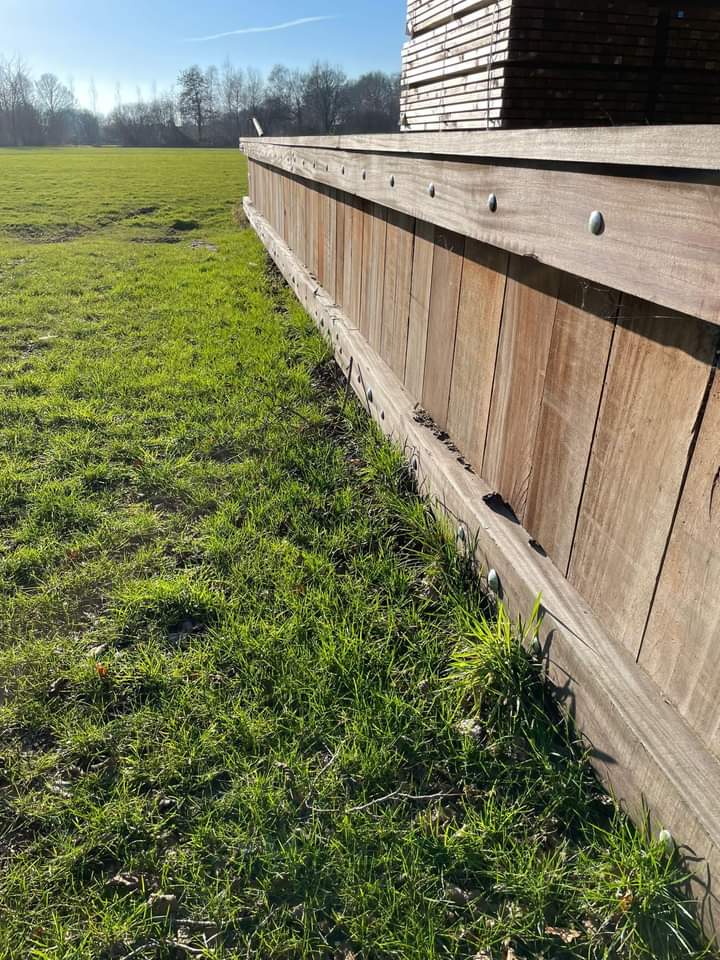
Competent authority
Which agency should you contact?
The water board and sometimes the municipality are usually involved in shoring. If in doubt, contact both — they will refer you to the appropriate agency.
The water board
In the vast majority of cases, the water board is the first point of contact. They manage regional waterways and enforce the Water board approval.
- → Assesses water profile, flow and safety
- → Digital counters for permits or preliminary consultations
- → For Drenthe, Friesland, Groningen, Flevoland and Overijssel
The municipality
In certain situations the municipality is also involved, especially in urban waters or protected areas.
- → Watercourse under municipal management (singles, canals)
- → Zoning plan with specific conditions
- → Protected cityscape or nature reserve
Rules and conditions
Common rules
Although the exact rules differ per water board, the following conditions are common:
Distance and profile
- → The revetment must not reduce the water profile — the flow capacity must be maintained
- → New revetments must usually be placed on the existing bank line
- → A maintenance strip of at least 1 to 5 meters (depending on the water board) must remain free for mechanical maintenance
Height and material
- → The height of the revetment should usually not extend more than 10 to 30 cm above ground level
- → The material must be durable and environmentally friendly — impregnated wood with toxic substances is not permitted by many water boards
- → FSC-certified hardwood and recycled plastic are usually accepted without objection
Protected zones
- → Additional requirements apply in Natura 2000 areas or protected nature zones
- → Work may not take place during the breeding season (March 15 - July 15) without an exemption
- → In the presence of protected animal species (otters, grass snakes, fish), an ecological study may be required
Exemptions
When is a permit not required?
Not all shoring work requires a permit. In many cases, an exemption or reporting obligation applies for:
- ✓ Replacement at the same location: replace existing sheet piling at exactly the same position, with the same or comparable dimensions
- ✓ Small waterways: Some water boards provide an exemption for narrow ditches (up to approximately 1 meter wide) that are managed in-house
- ✓ Ponds on site: protection around a pond entirely on your plot, without connection to public waterways
- ✓ Maintenance work: replacing some loose planks or repairing existing sheet piling
NB: an exemption is also possible reporting obligation to apply. Inform the water board in advance about the planned work, even if no formal permit is required.
Step by step
The application process
Applying for a water permit for sheet piling usually involves the following steps:
-
Preliminary consultation (recommended)
Contact the water board to explain your plans. Many water boards offer this free of charge and prevents rejections.
-
Submit application
Submit the application via the Online Environment Desk or the digital counter of the water board, including situational drawing, cross-section and material description.
-
Judgement
The legal processing period is 8 weeks. Simple requests are often processed within 4 to 6 weeks.
-
Permit received
Upon approval, you will receive a water permit with any conditions, such as implementation period and material specifications.
-
Pay fees
The costs vary per water board, usually between €0 and €500 for standard revetment projects. Please inquire in advance about the exact fees.
Practical tips
Tips for a smooth permit process
- ✓ Start on time: the permit process starts at least 8 to 12 weeks before the planned implementation
- ✓ Make use of preliminary consultation: an informal conversation with the water board prevents surprises
- ✓ Choose approved material: FSC-certified hardwood and recycled Prolock plastic are almost always accepted
- ✓ Provide complete documentation: incomplete applications will cause delays — always include drawings and photos
- ✓ Take the breeding season into account: Plan work preferably in autumn or early winter
- ✓ Save the permit: keep the permit decision well preserved, even after delivery - the water board can still check years later
- ✓ Inform the neighbors: In the case of shared waterways, it is wise to inform adjacent owners
Do you have questions about permits for your revetment project? We have extensive experience with projects throughout the Netherlands and can advise you on the usual requirements in your region. Contact us of request a quote.
Read more
Related topics
Revetment plaatsen
Step-by-step guide from preparation to finishing.
Read the manual →Shoring costs
Indicative prices per meter, including permit costs.
View costs →Materials
Order hardwood sheet piling and Prolock plastic directly.
To products →Request a quote
Free advice about permits and materials for your project.
Request a quote →Questions about permits for your project?
We have extensive experience with sheet piling projects throughout the Netherlands and are happy to advise you on the usual requirements in your region.